
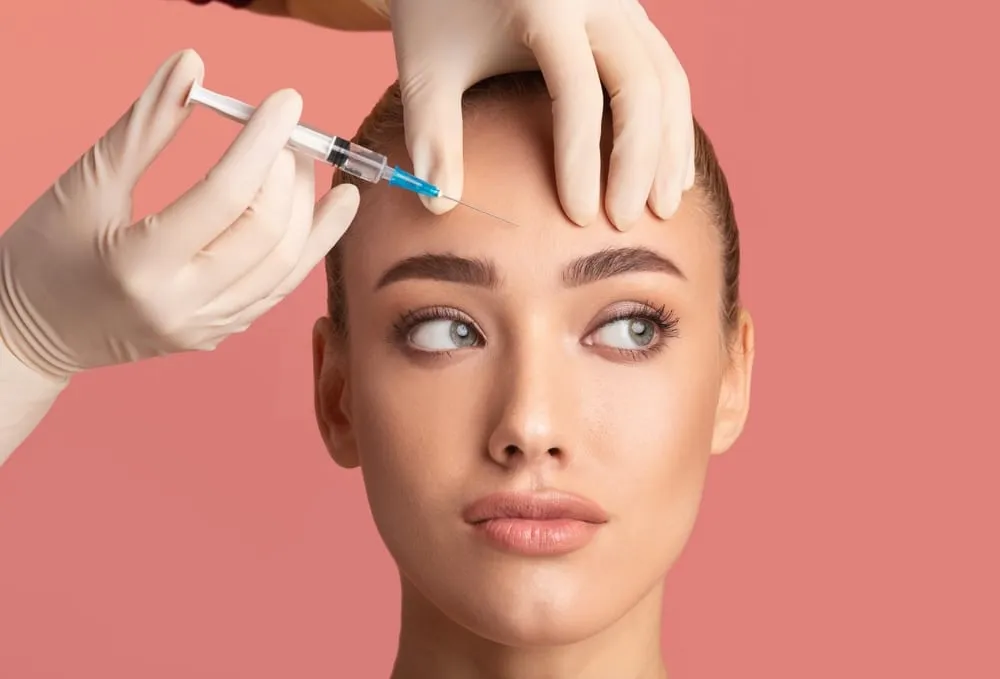
In a city as restless as New York, where every commute is measured in coffee refills and subway delays, maintaining a refreshed and youthful appearance is often a prerequisite for success. At Skincare Sommelier Beauty Lab & Med Spa, we believe that neuromodulator treatments are a team effort between our experts and your routine after Botox. While the injections take only minutes, following a proper Botox Aftercare Guide ensures your look stays natural, symmetrical, and long-lasting.
Whether you’re starting your journey with preventative Botox or you’re a regular at our Forest Hills clinic, the first 24 hours are the most critical. Mastering your post-Botox care is the secret to a flawless reveal and preventing complications like toxin migration.
“Our work at Skincare Sommelier sets the foundation, but the final, essential step happens at home, at work, or on a vacation. We consider the first 24 hours a collaborative effort: we provide the medical precision, and you provide the quiet environment your skin needs to lock in that refined look. We are here to support you through every hour of that transition.” – The Sommelier’s Team
First 24 Hours: Professional Botox Aftercare Instructions
The initial 24 hours post-treatment represent the critical integration phase. During this window, the botulinum toxin is actively binding to the nerve receptors at the neuromuscular junctions. To ensure the product remains localized and performs with maximum precision, adhering to professional Botox aftercare instructions is essential. Your habits during this period directly influence the stability of the toxin and the final aesthetic outcome.
Why the First 4 to 6 Hours Matter Most
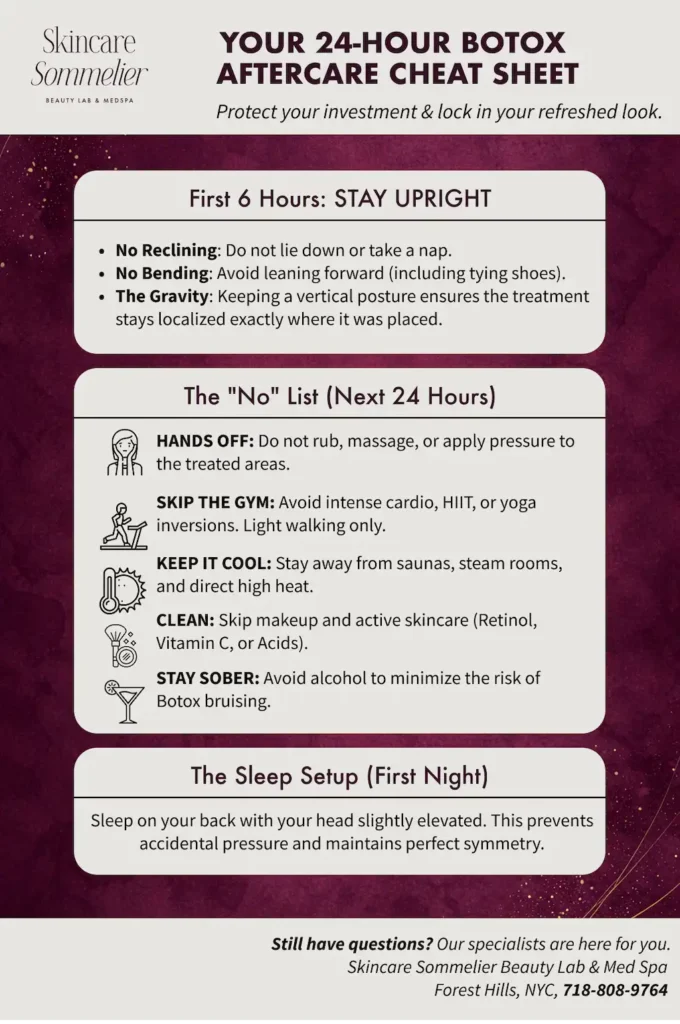
The most essential instruction in your Botox aftercare guide is to remain in a vertical position for at least four hours. Immediately following your treatment, the neuromodulator has not yet fully bound to the nerve receptors within the targeted muscle. Keeping your head upright ensures the toxin remains localized exactly where it was injected.
Activities like lying flat, bending forward, or looking down for extended periods can cause the protein to migrate toward adjacent muscles, leading to unintended relaxation. While eyelid ptosis (drooping) is the best-known risk for forehead injections, migration to other areas can be equally disruptive. For instance, with a Lip Flip or Masseter Botox, unintended spread of the toxin can result in temporary smile asymmetry or even difficulty using a straw. Staying vertical is the simplest way to protect your results.
What Not to Do After Botox: Your Aftercare Rules
To protect the precision of your Botox treatment and ensure the neuromodulator settles exactly where intended, certain daily habits should be temporarily paused. Understanding what not to do after Botox is the key to maintaining the structural integrity of your results.
For the first 24 hours, Skincare Sommelier recommends following these “no-go” guidelines:
- Avoid Physical Manipulation. Do not rub, massage, or apply pressure to the treated areas. This includes skipping tight hats, headbands, and aggressive face-washing. Mechanical pressure is a primary cause of toxin displacement to adjacent muscles.
- Pause Intense Workouts. Skip the gym for at least 24 hours. Increased blood flow and elevated body temperature from exercise can interfere with the protein’s ability to bind effectively to the injection site.
- Stay Away from High Heat. Avoid saunas, hot tubs, or steam rooms. Excessive heat causes vasodilation (widening of blood vessels), which may increase swelling after Botox or lead to unwanted toxin migration.
- Go Makeup-Free. We recommend a makeup-free face for the remainder of your “Botox day.” This keeps the injection sites sterile and free of bacteria, minimizing the risk of irritation or micro-infections.
- Limit Alcohol Consumption. While not a clinical requirement for the toxin itself, avoiding alcohol for 24 hours reduces the risk of bruising, as alcohol can act as a mild blood thinner.
- Mind Your Sleep Position. For the first night, try to sleep on your back. Keeping your face away from the pillow helps prevent accidental pressure and ensures symmetrical results.
Read More: Botox under eyes: Cost, Benefits, Before & After Results, and Possible Side Effects
Managing Botox Swelling and Bruising: What is Normal?
Edema (swelling) and ecchymosis (bruising) are natural physiological responses to the needle’s entry into the dermis. Even with the precision of our experts at Skincare Sommelier, individual vascularity and lifestyle factors directly influence how your skin reacts to the micro-trauma of an injection. It is important to view minor bruising after Botox as an expected part of the body’s healing process. Recognizing these temporary adjustments as signs of tissue integration, rather than complications, allows for a more relaxed and confident recovery experience.
How Long Does Swelling Last After Botox?
Immediately following your procedure, you may notice small ‘papules’ or bumps at the injection sites, often resembling mosquito bites. This is simply the localized volume of the saline-toxin solution as it begins to disperse into the muscle tissue. One of the most common questions our specialists hear is, ‘How long does swelling last?‘ While these initial bumps typically resolve within 30 to 60 minutes as the solution is absorbed, mild localized edema can occasionally persist for up to 24 hours. For those with more sensitive skin or a tendency toward inflammation, applying a light cold compress — without exerting any pressure — is an effective way to soothe the area and help it settle.
Bruising After Botox: Tips for Faster Healing
At Skincare Sommelier Beauty Lab & Med Spa, we use ultra-fine needles and specialized techniques to minimize tissue disruption, yet bruising from Botox can still occur if a microvessel is nicked during the process. If a small mark appears, it is a temporary stage of the healing cycle that can be managed with professional-grade aftercare. To support a faster resolution, we often recommend incorporating widely trusted options such as topical Arnica Montana or Bromelain supplements into your routine. Furthermore, clinical observations at the National Center for Biotechnology Information indicate that avoiding blood-thinning agents (such as aspirin and ibuprofen) for a few days before and after your Botox session can significantly shorten recovery and minimize the intensity of any visible bruising.
Read more: Botox Uses: Indicated & Off-Label Applications in New York
The Sleep Protocol: How to Sleep After Botox to Avoid Toxin Migration
Post-treatment positioning after Botox treatment is a key factor in ensuring your results stabilize as intended. After the precision-led approach our experts at Skincare Sommelier use to tailor each injection to your unique anatomy, the goal for the first night is to preserve that symmetry. Understanding how to sleep after Botox is more than just a recommendation. It’s a proactive step in protecting the intentional placement of the neuromodulator.
Can I Sleep on My Side or My Face?
The short answer: For the first night, the ideal position is sleeping on your back with your head slightly elevated.
Sleeping on your side or face in recovery after Botox injections exerts prolonged, localized pressure on the recently treated areas. This mechanical force can interfere with the toxin’s integration into the targeted muscle fibers, potentially leading to uneven distribution or migration. While it might feel like a temporary disruption to your routine, maintaining a neutral, back-sleeping position for the first 24 hours is the most effective way to safeguard your results. After this initial window, you can comfortably return to your preferred sleeping position without risk.
Why You Must Wait Before Lying Down After Botox
The directive to remain upright for 4 to 6 hours after your session is rooted in the physics of toxin absorption. Maintaining a vertical posture ensures that the protein remains localized at the injection site while it begins to bind to the nerve receptors. Transitioning to a horizontal position too soon increases blood flow to the face and alters tissue pressure dynamics, which can facilitate the spread of the toxin into non-targeted muscle groups. By staying upright, you are providing the neuromodulator with the stable environment it needs to perform with maximum precision.
“I always tell my clients that gravity is the invisible hand in your Botox results. Staying vertical isn’t just a suggestion — it’s the simplest, most effective way to ensure your symmetry remains exactly as we mapped it out,” – The Skincare Sommelier Team
Botox Lifestyle Adjustments: Exercise, Alcohol, and Heat in NYC
Living in New York City often means being in constant motion — from morning HIIT sessions to evening cocktails. However, achieving a flawless Botox result requires a brief pause in your high-energy routine. During the initial stabilization phase, physiological factors such as increased heart rate and vasodilation can directly interfere with the neuromodulator’s uptake into the muscle tissue. General Botox aftercare advice suggests that modifying your activity level for the first 24 hours is essential for avoiding unintended side effects.
Can You Exercise After Botox? The 24-Hour Rule
A common misconception is that you can head straight to the gym after your appointment. In reality, any activity that significantly raises your heart rate can compromise your results. When clients ask, “Can I exercise after Botox?“, our clinical recommendation is to wait 24 to 48 hours before returning to strenuous workouts.
The concern isn’t about sweat, but about blood circulation. Elevated blood flow can cause the toxin to disperse from the injection site before it has effectively bound to the targeted receptors. While light walking is perfectly fine, you should avoid high-impact cardio or any inverted positions (such as certain yoga poses) that shift blood flow directly to the face.
Drinking After Botox: Can You Have That Glass of Wine?
While it may be tempting to celebrate your NYC glow-up with a drink, drinking after Botox is generally discouraged for the first 24 hours. Alcohol acts as a vasodilator, meaning it expands the blood vessels and slightly thins the blood. This combination significantly increases the risk of bruising after Botox at the injection sites.
To maintain a clear, bruise-free complexion, focus on hydration instead. Proper fluid balance supports the skin’s natural healing process and helps flush out any systemic inflammation. Think of it as a 24-hour “detox” to ensure your “Botox day” yields the most refined aesthetic results.
Post-Botox Glow Needs to Stay Cool
Temperature control is a frequently overlooked aspect of post-Botox care. Excessive heat causes vasodilation (widening of blood vessels), which can increase swelling and, theoretically, facilitate toxin migration.
For the first 24 hours, we recommend avoiding:
- Hot tubs, saunas, and steam rooms.
- Extremely hot showers.
- Direct, prolonged sun exposure (especially during NYC’s humid summer months).
Keeping your body temperature regulated ensures the treatment remains localized and stable.
Read More: The Science Behind Infrared LED Sauna Therapy: How Light Therapy Enhances Wellness
The Botox Roadmap: What to Expect from Day 1 Through Day 14
It is common to feel a sense of anticipation — and sometimes a bit of uncertainty — when you don’t see an immediate shift in your reflection. Unlike dermal fillers, which provide instant volume, neuromodulators require time to interrupt the signaling between nerves and muscles. To manage your expectations, it is essential to follow the Botox progression from day 1 through day 7, as the transformation is a gradual physiological process rather than an overnight change.
Day 1-3: Waiting
The first few days after Botox are about what is happening beneath the surface. During this period, the toxin is actively being taken up by the motor nerve endings. You likely won’t see a visible reduction in wrinkles yet, and that is perfectly normal.
Some clients report a subtle sensation of “tightness” or a change in muscle feedback — often described as a slight heaviness. While this is frequently noted after forehead Botox injections, it can occur in any treated area as the muscles begin to respond to the initial nerve block. At this stage, your full range of motion is usually still intact. Don’t be alarmed if you can still squint or frown as you did before your appointment.
Day 7-14: The Final Reveal
By the end of the first week of Botox recovery, the smoothing effect becomes noticeably more apparent. So, how long does it take for Botox to work? While initial softening often starts around day 5, the treatment reaches its maximum efficacy at the 14-day mark. According to the American Academy of Dermatology, this is the point where the protein has fully saturated the targeted receptors, resulting in a refined, rejuvenated appearance.
At Skincare Sommelier, we emphasize the “14-day rule”. We suggest waiting the full two weeks after Botox injection before assessing your final look or considering a “touch-up.” Results are still evolving until this point, and rushing for more units too early can lead to an over-treated, stiff appearance. Our goal is always a look that is refreshed and smooth, yet still maintains the natural character of your expressions.
“Botox is not an instant mask. It’s a gradual softening of your expressions. We always ask for 14 days of patience because that is the natural rhythm your body needs to reveal the final, polished result. There is no need to rush for a touch-up in the first week. If you trust the timeline and let your muscles settle naturally, the most authentic version of your ‘refresh’ will emerge on its own.” – The Sommelier Team
The “Oops” Moment: I Forgot and Laid Down After Getting Botox
We are all human, and in the relentless pace of New York City, it’s easy to slip back into your old habits — whether it’s leaning over to grab your keys or accidentally taking a quick nap. If you find yourself panicking because you forgot and lie down after getting Botox, the first thing to do is take a breath.
While the “upright rule” is vital for optimal precision, a brief lapse in posture doesn’t automatically mean your treatment is ruined. Modern neuromodulators such as Botox Cosmetic and Dysport are designed to promote efficient tissue integration. If you’ve spent a few minutes in a horizontal position too early, follow this simple aftercare checklist:
- Return to a Vertical Position. As soon as you realize the slip-up, sit up or stand up. The goal is to stop any further potential migration of the toxin by letting gravity work in your favor again.
- Avoid the Urge to “Fix” It. Do not rub, massage, or press on the area where you lie down. Trying to “push” the product back can actually cause more displacement.
- Monitor for Asymmetry. Over the next 48 to 72 hours, observe your results as they begin to settle. Look for any unintended muscle relaxation, such as a slight droop of the eyelid, an uneven smile, or a brow lift.
- Stay Calm and Patient! Remember that most minor lapses do not lead to clinical complications. Stress can increase blood flow to the face, so staying calm is actually part of your Botox aftercare.
If you do notice any significant changes in symmetry or experience any persistent discomfort, contact our Forest Hills clinic in NY immediately. At Skincare Sommelier Beauty Lab & Med Spa, our relationship with our clients extends far beyond the injection chair. Our specialists are here to provide a professional assessment and guide you through every stage of your reveal.
Read More: Botox vs. Dermal Fillers: Wrinkle Treatment Guide
Common Side Effects: Dealing with Headache After Botox
A sensation of mild pressure or a localized headache after Botox is a relatively common part of the post-treatment experience. For most, this isn’t a cause for alarm but rather a sign that the body is adjusting to its new muscle dynamics. At Skincare Sommelier, we believe that understanding the “why” behind these sensations is the best way to ensure a stress-free Botox recovery.

Why Does a Headache Happen?
The primary cause of a post-Botox headache is often muscle compensation. When we relax a specific group, such as the frontalis (the forehead muscle), the surrounding muscles may temporarily overcompensate to maintain your usual facial expressions. This shift in muscle recruitment can lead to mild tension.
Additionally, a headache after Botox can be a natural physiological response to the mechanical stimulus of the injection itself. This is a highly individual reaction and does not reflect the treatment’s success. For those receiving forehead Botox, a temporary feeling of “heaviness” is also common as the brain recalibrates how to move the brow area without the full engagement of the relaxed muscles.
Safe Ways to Support Your Botox Aftercare Mindfully
If you experience discomfort, our first recommendation is to prioritize rest and hydration. Maintaining a stable fluid balance and keeping the body cool are your most effective defenses against both tension and visible Botox bruising.
To manage any mild discomfort safely, we suggest:
- Optimal Hydration – increase your water intake to help your system process the inflammation more efficiently. Proper hydration also supports vascular health, which is essential for minimizing bruising from Botox.
- A Cool Environment – staying in a temperature-controlled space and avoiding NYC’s humidity or direct heat can prevent vasodilation, which often worsens headaches.
- Gentle Rest – allow your body the time it needs to integrate the treatment without added stress. Avoiding strenuous activity for the first 24 hours is a simple way to prevent blood flow from intensifying any localized Botox bruising.
When to Contact Us: While mild tension is normal, if you experience a severe, persistent headache after Botox or any visual changes, please contact our Forest Hills clinic, NY, immediately. Our specialists are available to provide a professional assessment and ensure your recovery is progressing exactly as it should.
FAQ: Botox Aftercare
How long does Botox swelling take to subside?
Most localized Botox swelling or small “papules” (bumps) at the injection sites resolve within 60 minutes as the solution is absorbed into the tissue. However, if you have sensitive skin, minor inflammatory swelling is normal and typically disappears within 24 hours. Using a light cold compress (without pressure) can help speed up this process.
Can I wash my face after a Botox treatment?
Yes, you can wash your face after Botox, but be extremely gentle. We recommend waiting at least 6 to 12 hours before applying any products. When you do wash, use lukewarm water and a gentle, non-exfoliating cleanser. Avoid scrubbing or circular motions that could exert mechanical pressure on the treated areas, as this can interfere with toxin stabilization.
When is it safe to fly after Botox?
While there is no absolute contraindication, we generally recommend waiting 24 to 48 hours before flying after Botox. The primary concern is the significant shift in cabin pressure, which can, in theory, exacerbate localized swelling or alter the distribution of the neuromodulator before it fully binds to receptors. Additionally, long-haul flights often involve sleeping in cramped positions, which makes it harder to follow the “upright rule” necessary for a symmetrical result.
Can I use Tretinoin or Retinol after my Botox appointment?
You should skip your active topicals, including Retinol after Botox, for the first 24 hours. It is essential to let the injection sites fully “seal” to prevent irritation or micro-infections. Furthermore, applying potent actives like Tretinoin usually requires vigorous rubbing of the skin, which should be avoided on your “Botox day” to prevent any accidental toxin migration.
How long does forehead Botox last?
On average, results for forehead Botox last between 3 and 4 months. However, longevity is highly individual. Your metabolic rate, the strength of your facial muscles, and even the dosage used during your appointment play a role. At Skincare Sommelier, we customize the units to ensure a result that stays smooth and refreshed for as long as possible without losing your natural expression.
Conclusion: Trusting the Process at Skincare Sommelier
A flawless outcome results from a perfect balance between expert technique and mindful Botox aftercare. By prioritizing these first 24 hours, you aren’t just following a set of instructions — you are protecting your investment and ensuring your results settle with total precision.
At Skincare Sommelier Beauty Lab & Med Spa, we prioritize a seamless recovery experience, providing the expert support and guidance you need as your results evolve. Whether you are managing minor swelling after Botox or looking forward to seeing your final, refreshed appearance, our Forest Hills, NYC, team is here to assist you every step of the way.
Ready to refine your look? Schedule your consultation at Skincare Sommelier today.