

The “Notox” trend has sparked a lot of curiosity — and a lot of questions. Can you really turn back the clock without injectables? Are devices replacing needles? Is Botox still worth it? At Skincare Sommelier in Forest Hills, we love these conversations because they lead somewhere important: understanding that RF microneedling and Botox are not rivals. They are two distinct tools, each exceptional at what it does — and often most powerful when used together.
The “Notox” Moment: What Skincare Products Can and Can’t Do
The “Notox” movement grew out of something real: a desire to look naturally refreshed, without feeling like you’ve had “work done.” For many people, the journey starts with skincare — serums, creams, and peptide-packed moisturizers that promise clinical results at home.
And to be fair, modern topical formulations have come a long way. Active ingredients like AHA and BHA exfoliants, retinoids, and certain peptide systems do interact with the skin at a meaningful level — refining texture, supporting cell turnover, and improving overall radiance. Some professional-grade topicals used in clinical settings, such as chemical peels and prescription retinoids, go further still.
That being said, just like there is and should not be one size fits all approach, there should be no expectation that one product or one modality addresses and resolves all skin concerns as well.
Whether one is considering Botox or collagen stimulators such as Radiesse or RF microneedling, understanding one’s goals and priorities plays a vital role in selecting the service to begin with.
That’s the moment a good consultation changes everything. RF microneedling and Botox stand out not as competitors, but as treatments in entirely different aspects of skin rejuvenation.
The Skincare Sommelier Experts say: “We have consciously moved toward a systematic, scientifically grounded approach to rejuvenation. Our goal is not to temporarily mask age-related changes, but to offer a comprehensive clinical protocol that restores the dermis’s structure from within.”
How Botox Works — and Why It’s More Than Just Wrinkle Relaxation
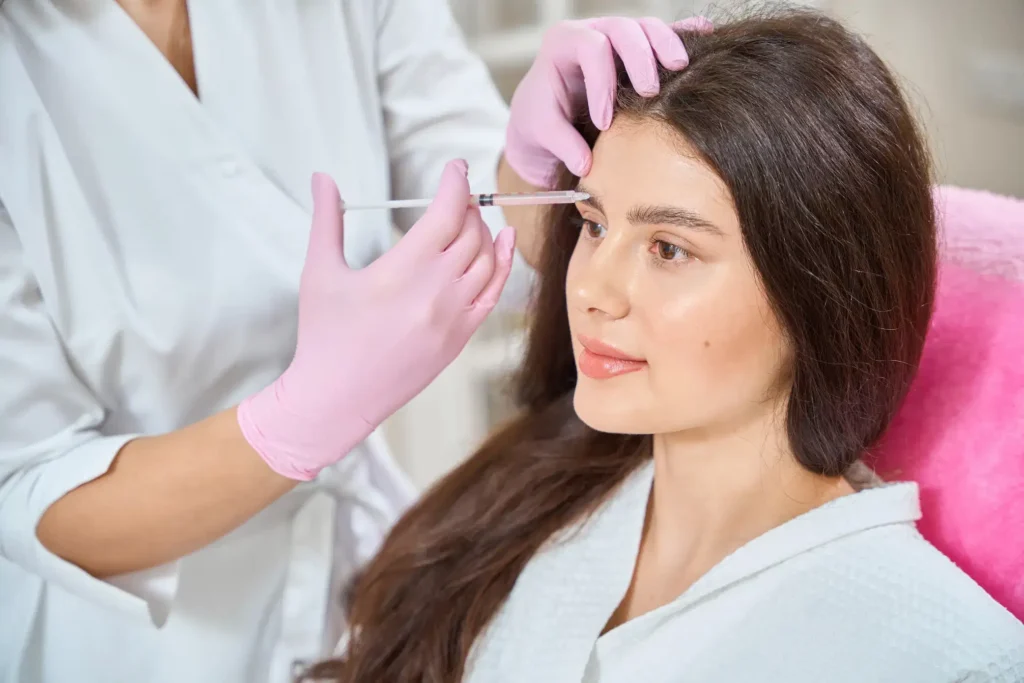
Botox (botulinum toxin type A) is one of the most studied aesthetic treatments in the world. Yes, it relaxes facial muscles to soften expression lines. But in the hands of a skilled injector, it does considerably more than that.
- The mechanism: Botox works by blocking the release of acetylcholine at the neuromuscular junction, temporarily reducing muscle contraction. The result: forehead lines, crow’s feet, and glabellar lines soften — and, importantly, stop deepening over time.
- The lifting effect: Strategic placement of Botox can create a visible lift — elevating the brow, opening the eye area, softening the jawline, and refining facial contours. It’s about working with its natural structure to restore a more rested, youthful appearance and not freezing the face.
- The glow factor: Relaxed facial muscles improve surface microcirculation, which translates into a visible skin radiance — something clients often notice even before they register the wrinkle reduction.
- The rosacea connection: Botox has shown a notable calming effect on skin prone to redness and flushing. Reducing the inflammatory response in the treated area can help quiet rosacea flares and create a more even, settled complexion — a benefit that often surprises first-time clients.
- The longevity: Results typically last three to four months, with cumulative benefit over time — regular treatments can gradually train muscles to contract less forcefully, meaning softer lines even between sessions.
How RF Microneedling Tightens Skin from Within
RF Microneedling is a device-based procedure that combines two powerful methods: Microneedling and deep radiofrequency (RF) heating. Where Botox works at the neuromuscular level, RF microneedling works at the architectural level of the dermis — stimulating the skin’s own regenerative processes to rebuild from within. Sylfirm X skin tightening works in the deep layers of the dermis, completely eliminating the risk of burns. At our clinic, the procedure is performed using the innovative Sylfirm X platform. This technology has proven clinical efficacy and works precisely at the cellular level: it strengthens tissues and repairs damaged blood vessels, restoring the skin’s youthfulness and even tone.
The mechanism of action involves three stages:
- Neocollagenesis. In response to controlled microdamage, fibroblasts are activated, triggering the production of new types I and III collagen, as well as elastin. This process continues for another 3–6 months after the procedure.
- Collagen denaturation. Controlled thermal exposure breaks down pathologically altered and stretched collagen fibers.
- Dermal remodeling. The formation of a renewed extracellular matrix increases dermal density, improves its turgor and texture, and helps smooth the skin and reduce the appearance of static wrinkles, which are visible even at rest.
Enhancing RF Microneedling Results: The Role of Exosomes
Pairing RF microneedling with exosome therapy is one of the most effective ways to amplify and accelerate skin regeneration — and one of our most requested combinations at Skincare Sommelier. When applied immediately after the Sylfirm X procedure, exosomes penetrate through the open microchannels into the dermis, where they exert a pronounced anti-inflammatory effect and stimulate collagen production. Additionally, it helps suppress melanogenesis, which prevents unwanted hyperpigmentation and ensures an even skin tone. Thanks to this approach,the healing process is accelerated, reducing the full recovery period to just 5 to 10 days. Learn more about exosome therapy: What are Exosomes?
RF Microneedling vs Botox: What Each Actually Treats
The comparison below helps clarify the clinical application of each procedure:
| Criteria | Botox | RF Microneedling |
|---|---|---|
| Primary Action | Neuromuscular precision — relaxes targeted muscles, lifts contours, calms inflammation | Biological dermal remodeling — rebuilds collagen, tightens, and refines from within |
| Target Concerns | Dynamic wrinkles, brow ptosis, facial asymmetry, rosacea-prone skin, lack of radiance | Static wrinkles, skin laxity, enlarged pores, uneven texture, pigmentation |
| Ideal For | Forehead lines, crow’s feet, glabellar lines, brow lift, jawline refinement, glow enhancement | Skin tightening, pore refinement, texture improvement, early laxity, melasma, scarring |
| Longevity | 3–4 months, with cumulative benefit over time | 12–18 months |
| Downtime | Minimal — most clients return to normal activity the same day | Redness fades quickly, full skin recovery typically 7–14 days |
For those who want a deeper understanding of how Sylfirm X differs from other radiofrequency technologies, a detailed comparison of Sylfirm X and Morpheus8 is available on our blog.
RF Microneedling or Botox: How to Know Which One Is Right for You
If you’ve been going back and forth on this — reading articles, watching videos, feeling more confused with every scroll — you’re not alone. The amount of information (and misinformation) out there about both treatments can make a simple question feel overwhelming.
Here’s what actually matters: your skin, your concerns, and what you want to see in the mirror. Not what worked for someone else’s face.
The difference between RF microneedling and Botox isn’t about which one is better — it’s about what each one is designed to do. Once that clicks, the right starting point usually becomes clear.
Botox may be the right first step if:
- You notice lines on your forehead or around your eyes that appear when you smile or raise your brows — and they’re starting to linger even when your face is relaxed.
- Your face looks tired or heavy, and you feel like your brows or eye area have shifted downward over time.
- Your skin tends toward redness, flushing, or visible sensitivity that flares unpredictably.
- You want a low-commitment way to start — something with minimal downtime, fast results, and the ability to see how your face responds before exploring longer treatments.
- You’re curious about looking more rested and radiant, without any dramatic change to how you look.
RF microneedling may be the right first step if:
- Your skin feels thinner, looser, or less firm than it used to — especially around the cheeks, jawline, or neck. Even a subtle loss of density or “bounce” is a signal that the dermis needs structural support.
- You’re dealing with enlarged pores, rough or uneven texture, or a complexion that looks dull.
- Acne scarring, post-inflammatory hyperpigmentation, or melasma.
- You want a treatment that works with your skin’s own biology — stimulating collagen and elastin production.
- You don’t have significant wrinkles yet, but you want to maintain skin architecture and density before age-related changes accelerate.
- Overall skin quality, firmness, and radiance that you want to restore.
To better understand all the benefits of microneedling, read our article “Microneedling Benefits for Skin.”
Starting something new — especially when it involves your face — takes trust. At Skincare Sommelier, every consultation begins with a real conversation: what you’re seeing, what you’re hoping for, and what makes you nervous. From there, we build a plan that makes sense for you — at your pace, with full transparency about what each treatment involves, what to expect, and whether it’s the right moment to begin.
You don’t need to arrive with all the answers. That’s what we’re here for.
When Combining RF Microneedling and Botox Makes Sense
For many clients, the most effective approach isn’t choosing between RF microneedling and Botox — it’s understanding how they work together. Botox and RF microneedling for skin tightening act at different anatomical levels and can therefore complement each other as part of a personalized rejuvenation protocol. These two treatments don’t compete – they complement.
A sequential combination of these methods is appropriate when a client simultaneously exhibits expression lines and signs of structural loss of dermal density, as well as sagging or pronounced skin texture irregularities requiring device-based correction.
- Botox addresses what’s happening at the neuromuscular level — softening dynamic lines, lifting contours, calming inflammation, and adding radiance.
- RF microneedling addresses what’s happening deeper in the dermis — rebuilding collagen architecture, restoring firmness, refining texture, and correcting pigmentation.
Together, they cover a range of concerns that neither can fully resolve alone.
A combined protocol makes particular sense when:
- You have both expression lines and early laxity — Botox smooths the surface while RF microneedling rebuilds what’s underneath
- You want to extend and deepen your Botox results by improving overall skin quality and density between sessions
- Your goal is comprehensive rejuvenation: not just fewer lines, but better skin — firmer, clearer, more luminous
- You’re transitioning from purely injectable treatments and want to add a regenerative foundation to your protocol
The Skincare Sommelier Experts say: “Some of our most striking results come not from a single treatment, but from a protocol that layers Botox precision with RF microneedling regeneration. When you address both the muscle and the dermis, the outcome looks more like your skin simply at its best — rested, firm, and naturally alive.”
FAQ: RF Microneedling vs Botox
Is RF microneedling a true Botox alternative?
RF microneedling and Botox work through completely different mechanisms. Depending on your goals, you may find that one is exactly what you need — or that both, used together, deliver results neither could achieve alone.
How many RF microneedling sessions do I need to see results?
First improvements are often visible after a single session, but a course of three treatments is typically recommended for optimal, lasting results. Because RF microneedling stimulates your skin’s own collagen production, results continue to develop for three to six months after each session.
Is Botox safe? What should I expect from my first treatment?
Botox is one of the most extensively studied aesthetic treatments available, with decades of safety data behind it. At Skincare Sommelier, every treatment begins with a thorough consultation — we assess your facial anatomy, discuss your goals, and walk you through exactly what the procedure involves, what you’ll feel, and what to expect afterward. First-time clients are always welcome to ask every question they have before we begin.
How long do results last for each treatment?
Botox results typically last three to four months, with a cumulative benefit over time — regular treatments can gradually soften muscle activity, meaning lines stay smoother even between sessions. RF microneedling results last twelve to eighteen months, with skin quality continuing to improve for several months after treatment as new collagen matures.
Is RF microneedling safe for all skin tones?
Yes. The Sylfirm X platform is FDA-approved for all skin types and tones, including those prone to hyperpigmentation. It is particularly effective for treating melasma, sun damage, and post-inflammatory pigmentation across the full Fitzpatrick scale.
Can I get RF microneedling if I already have Botox?
Yes. Many clients combine both treatments as part of a comprehensive anti-aging strategy.
What can Botox do beyond smoothing wrinkles?
Quite a lot. Botox can lift the brow and open the eye area, refine the jawline, calm redness and rosacea-prone skin, and add a visible glow by improving surface microcirculation.
RF Microneedling and Botox at Skincare Sommelier: Your Skin, Your Protocol
At Skincare Sommelier in Forest Hills, Queens, we don’t start with treatments — we start with your skin. Every protocol is built on a detailed clinical assessment: your skin’s structure and density, your Fitzpatrick phototype, your history of aesthetic treatments, and the changes that concern you most right now.
Both RF microneedling and Botox are core parts of what we offer — not because they’re trending, but because they work. Each one is exceptional at what it does. Together, they give us the tools to address almost any concern a client walks in with, from the first fine line to more complex structural changes.
The Sylfirm X platform we use for RF microneedling was selected for its precision, its clinical track record, and its ability to be finely calibrated to the individual face. Our approach to Botox is equally considered — placement, dosage, and timing are always guided by anatomy and outcome, never by formula.
Build Your Anti-Aging Protocol With Our Team in Forest Hills
Choosing between RF microneedling and Botox — or deciding whether both belong in your plan — is exactly the kind of conversation we have every day. There are no wrong questions, no pressure, and no one-size-fits-all answers here.
At the Skincare Sommelier in Forest Hills, New York, our specialists develop personalized skincare plans based on clinical assessments, cutting-edge technologies, and long-term goals for maintaining skin health.
We invite you to schedule a consultation with our team in Forest Hills. Come as you are, with whatever questions you have. We’ll take it from there.