
Quick Answer: What is a Non-Surgical Facelift Procedure?
A liquid facelift is a non-surgical facial rejuvenation protocol that combines Botox (or another neuromodulator) with dermal fillers to restore lost volume, sharpen facial contours, and counteract the muscle-driven descent that defines facial aging — without incisions or surgical downtime. The procedure addresses two root causes of an aged appearance: depletion of the deep fat pads that support facial structure, and the progressive dominance of depressor muscles over their lifting counterparts.
At Skincare Sommelier Beauty Lab & Med Spa in Forest Hills, Queens, every liquid facelift protocol is anatomy-driven and built around the individual client — not a standardized package.
Table of Contents
The Science Behind a Liquid Facelift: Does Botox Give Your Face a Lift?
The lifting effect occurs through a combination of neuromodulation and structural volume restoration. Facial aging is governed by a tension between the levator muscles and the depressor muscles. Clinical observation indicates that as the face ages, depressor muscles become hyperactive, dominant over their lifting counterparts, resulting in jowls and the loss of the youthful V-shape. A liquid facelift restores this balance. In the right treatment plan, Botox gives your face a lift by reducing the downward pull of overactive muscles and supporting a more youthful contour. Learn more about how long Botox results typically last in Skincare Sommelier’s guide.
Full Face Botox Lift: Muscle Relaxation
Full face Botox targets specific depressor muscles to reduce their downward pull, allowing the lifting musculature to work unopposed. Key targets include:
- Depressor Anguli Oris (DAO): Relaxing this muscle lifts the corners of the mouth.
- Platysma bands: Botox injected into the vertical neck cords releases traction on the lower jawline – the basis of the “Nefertiti Lift”.
- Masseter: reducing a hypertrophied jaw muscle slims the lower face and restores the V-contour.
- Mentalis: softening chin tension reduces pebbling and lower-face heaviness.
Unlike a standard forehead treatment that merely smooths lines, a full face Botox lift focuses on the complex interplay of facial vectors, releasing the tension that leads to sagging. To better understand how these injectables differ and complement each other, you can explore our wrinkle guide: Botox vs. Dermal Fillers.
Dermal Fillers: Restoring Volume and Structural Support
Botox alone cannot restore what volume loss has taken away. Over years, the deep fat pads of the face simply deflate and migrate downward. Fillers don’t puff things up—they restore the scaffolding that was there to begin with. Aging depletes the deep fat compartments of the face and causes bone resorption, causing skin to sag. Dermal fillers rebuild this scaffolding:
- Midface (cheekbones). Restoring zygomatic projection elevates the midface and indirectly softens nasolabial folds.
- Temples. Preventing hollowing that gives a gaunt, skeletal appearance.
- Jawline & pre-jowl sulcus. Sharpening lower face definition and reducing the appearance of jowling.
Skincare Sommelier Team says: “Every treatment begins with a full kinetic facial analysis — assessing the face in motion, not just at rest — to ensure results remain balanced, natural, and never overfilled.”
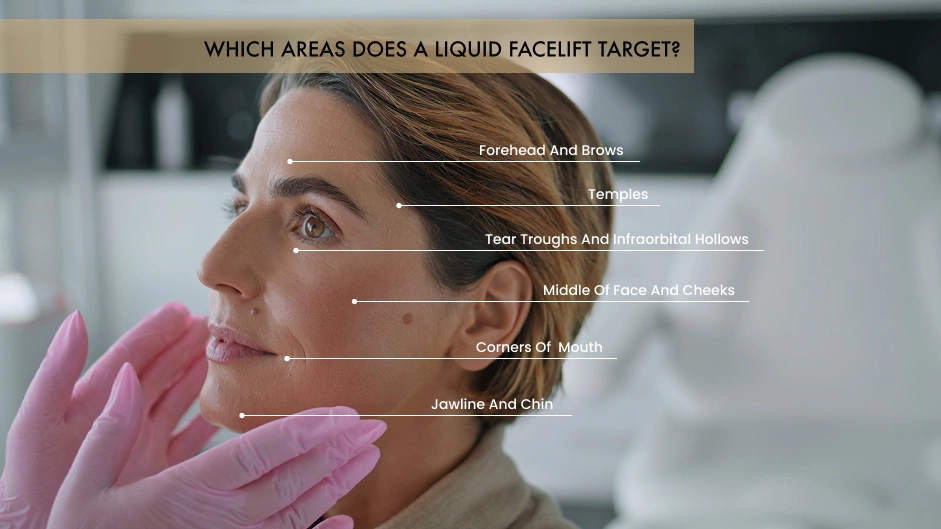
Which Areas Does a Liquid Facelift Target?
The liquid often focuses on areas such as your forehead and brows, temples, the middle of your face and cheeks, the tear troughs and infraorbital hollows, the corners of your mouth, your jawline, chin, and even the muscle bands in your neck.
What a liquid facelift involves for you, specifically, will depend on a few things: your natural facial structure and what you’re hoping to achieve, both of which are addressed at consultation.
Am I a Good Candidate for a Liquid Facelift?
You may be an excellent candidate if you:
- notice early-to-moderate jowling, volume loss, or drooping mouth corners;
- want significant rejuvenation without surgical downtime;
- are between 35–65 with reasonable skin elasticity;
- are in your late 30s–40s and want to proactively preserve facial contour.
Clients with severe skin laxity or significant excess skin may achieve better results with surgical lifting procedures.
By the Numbers: The Rise of Non-Surgical Rejuvenation
According to the American Society of Plastic Surgeons (ASPS) 2024 Plastic Surgery Statistics Report, minimally invasive cosmetic procedures account for the overwhelming majority of aesthetic treatments performed in the United States, with Botox and dermal fillers consistently ranking as the #1 and #2 most requested procedures nationwide. In 2023 alone, over 9.3 million Botox treatments and 4.3 million filler treatments were performed — numbers that reflect not a trend, but a clinical standard.
Managing Expectations: Liquid Facelifts vs. Traditional Surgery
| Factor | Liquid Facelift | Surgical Facelift |
|---|---|---|
| Incisions | None | Yes |
| Downtime | 24–72 hours | 2–4 weeks |
| Addresses excess skin | No | Yes |
| Volume restoration | Yes | Limited |
| Results duration | 12–18 months | 5–10 years |
| Reversibility | Partial (HA fillers dissolve) | Permanent |
While the results of a liquid facelift are transformative, it’s vital to distinguish its capabilities from surgery: it cannot physically excise skin. A common question is, how long does a Botox face lift last? Botox effects in neuromodulator-based lifting typically last 3–5 months, depending on the treatment zone and individual metabolism. While the overall lifted effect from the combined protocol can be maintained for 12–18 months with periodic touch-ups.
When a Liquid Facelift May Not Be Enough
Clients with severe skin ptosis, Grade III–IV jowling, or significant submental fat accumulation may require a surgical consultation. At Skincare Sommelier, if injectables cannot safely achieve the desired result, we say so — and provide trusted referrals.
What to Expect: The Liquid Facelift Experience at Skincare Sommelier
The journey to a refreshed look at our Forest Hills clinic follows a rigorous clinical protocol:
- Facial Analysis. A comprehensive kinetic assessment maps muscle activity, fat pad displacement, bone structure, and skin quality before any product is used.
- Treatment Planning. A tailored protocol is designed — which zones receive facelift Botox injections versus filler, which products, and in what sequence. No universal formula is applied.
- Topical Anesthesia. Prescription numbing cream is applied 20–30 minutes prior to injection.
- Precision Injection. Botox is administered first to establish the neuromuscular baseline; fillers follow. The full session takes approximately 45–75 minutes.
- Follow-Up at 2 Weeks. A complimentary review appointment ensures optimal Botox settling and filler integration, with minor refinements available if needed.
For a full breakdown of what to avoid and how to care for your skin in the days following treatment, see the Skincare Sommelier Botox Aftercare Guide.
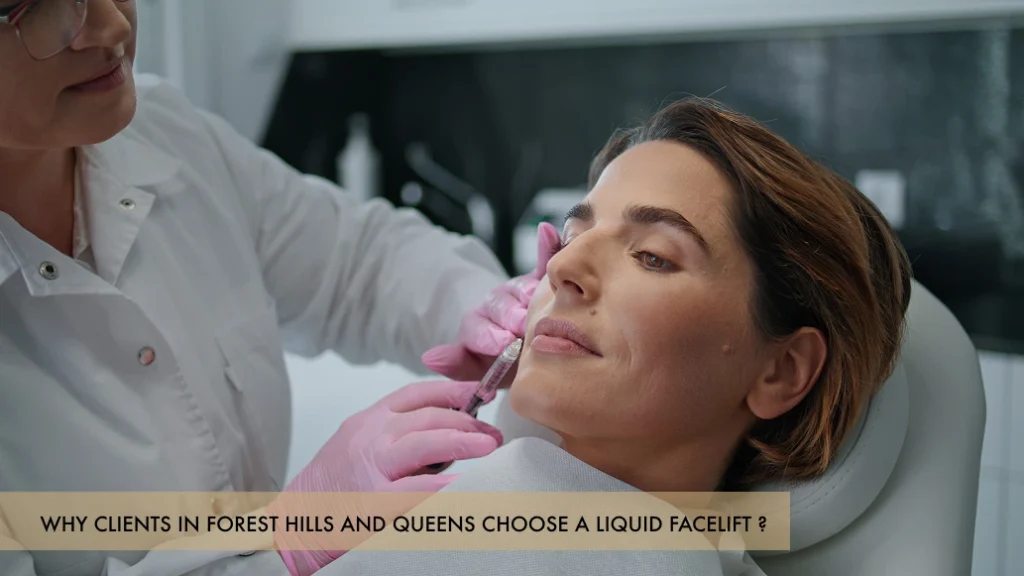
Why Clients in Forest Hills and Queens Choose a Non-Surgical Liquid Facelift?
Our Forest Hills clinic attracts people from all over, including nearby Rego Park, Kew Gardens, Jamaica Estates, and other parts of the NYC area. They choose us because we offer a bespoke protocol, kinetic analysis, and an anatomy-first approach. We focus on your unique face first, not just pushing products.
Dosage and Customization: Botox Face Lift How Many Units Do You Need?
Dosage depends on muscle mass, gender, treatment zones, and prior Botox history. A common question regarding the Botox face lift: how many units will I need? The exact answer really comes down to your unique face. But even though everyone is different, here are some typical ranges we usually see:
| Treatment Zone | Typical Botox Range |
|---|---|
| Glabella + Forehead | 30–50 units |
| Brow lift (lateral) | 2–5 units/side |
| Crow’s feet | 10–15 units/side |
| DAO + Mentalis | 7–14 units |
| Platysma / Nefertiti Lift | 25–50 units |
| Masseter | 20–40 units/side |
A comprehensive full face Botox protocol may involve 80–150+ total units. Filler volume for moderate full-face restoration typically ranges from 3–6 syringes across multiple zones. An in-person assessment at our Forest Hills clinic is the only responsible way to determine the right protocol for your anatomy.
FAQ: Liquid Facelifts
Is a liquid facelift safe?
Botox has been FDA-approved for cosmetics since 2002. HA fillers are reversible with hyaluronidase if needed. Risks exist: bruising, asymmetry, and rare vascular complications. When performed by a qualified aesthetic injector, complications are uncommon and, when they occur, addressable.
What’s the difference between a liquid facelift and regular Botox?
Standard Botox treats one or two isolated areas. A liquid facelift is a full-face protocol combining strategic neuromodulator placement across multiple depressor muscle groups with dermal fillers for structural volume restoration. The goal shifts from wrinkle reduction to facial architecture restoration.
Can a liquid facelift lift jowls?
Yes, with limits. Botox face lift for jowls relaxes the DAO and platysma to release inferior tension, while fillers at the pre-jowl sulcus and mandibular border sharpen definition. Most effective for mild-to-moderate jowling.
How much does a liquid facelift cost in NYC?
In the NYC metro area, a full protocol typically ranges from $2,500 to $6,000+ per session, reflecting product quality and provider expertise. We do not recommend selecting a provider on price alone.
How often do I need to repeat the treatment?
Botox results typically last about 3 to 5 months. Dermal fillers last for different amounts of time: 6 to 9 months in areas that move a lot, and 12 to over 18 months when placed deeper for structural support.
Can I combine a liquid facelift with laser treatments?
Yes. Laser and radiofrequency modalities address skin texture and surface laxity that injectables cannot fully resolve.
What’s the recovery time after a liquid facelift?
In most cases, patients are able to resume their usual daily routines within 24–48 hours. Any mild swelling or bruising generally fades within about 3–7 days. To ensure the best possible integration of your treatment, we advise patients to skip intense workouts, alcohol, and heavy sun exposure for the first 48 hours post-procedure.
Conclusion: Is a Liquid Facelift Worth It?
If you’re experiencing early-to-moderate facial volume loss and facial muscle laxity, this is considered one of the best non-surgical options available right now. It can make you look refreshed and measurably more lifted and restored. You won’t have to deal with any recovery time like you would after surgery. It won’t, however, replace a surgical facelift if you have a lot of extra skin. But for the right candidate, the combination of full face Botox and dermal fillers can meaningfully restore what aging has taken away.
At Skincare Sommelier Beauty Lab & Med Spa in Forest Hills, Queens, every liquid facelift begins with listening and ends with a plan built entirely around your face.
Not sure if you’re a candidate? Schedule a bespoke analysis at Skincare Sommelier Beauty Lab & Med Spa in Forest Hills. Our experts will craft a personalized liquid facelift plan tailored to your unique anatomy, ensuring a refreshed, natural look that feels entirely like you.