
Quick Answer: Botox Areas at a Glance
The seven most popular Botox areas treated at med spas across New York:
| Zone | Typical Units | Onset |
| Forehead lines | 10–25 | 3–7 days |
| Frown lines (“11s”) | 15–30 | 3–5 days |
| Crow’s feet | 10–20 per side | 3–7 days |
| Eyebrow lift | 4–12 per side | 5–10 days |
| Bunny lines | 5–10 | 5–7 days |
| Lip lines & gummy smile | 2–6 / 3–6 | 5–10 days |
| Chin & jawline/masseter | 5–40 | 2–6 weeks |
Botox temporarily relaxes specific muscles. It softens dynamic wrinkles — lines created by movement. Results last 3–4 months on average. Every plan is anatomy-specific; these ranges are clinical guidelines, not fixed numbers.
Table of Contents
Why Understanding Botox Areas Matters
People in Forest Hills, Queens, and across New York City search for Botox treatment areas more than almost any other aesthetic topic. And the question behind most of those searches is the same: Will this look natural on me?
The answer depends less on which zones are treated and more on how precisely the treatment is mapped to your anatomy. Knowing the common Botox areas before your consultation helps you:
- Ask the right questions instead of nodding along
- Understand why your injector recommends one zone over another
- Set realistic expectations for results, timeline, and maintenance
- Avoid over-treating areas that don’t need it
“The clients who come in with some baseline knowledge always have better outcomes, because they know what questions to ask. And that changes the communication between the injector and you.” — Clinical specialist, Skincare Sommelier Beauty Lab
What Are Botox Areas?
Botox (botulinum toxin type A) blocks nerve signals to targeted muscles. When the muscle can’t contract fully, the overlying skin smooths out. The effect is temporary — the body metabolizes the toxin over 3–4 months, and muscle activity gradually returns.
Cosmetic vs Medical Areas of Botox
Botox treatment areas fall into two categories:
- Cosmetic areas — zones where muscle movement creates visible wrinkles or undesirable contour (Forehead, glabellar complex, crow’s feet, perioral lines, nose, chin, jawline)
- Medical areas — zones where botulinum toxin addresses a functional condition (Masseter (bruxism, jaw tension), underarms and palms (hyperhidrosis), head and neck muscles)
Understanding both categories helps you recognize when Botox might offer more than aesthetic improvement.
Read more: Botox Aftercare Guide: Everything You Need to Know About Swelling, Bruising, and the First 24 Hours
Botox Areas on Face: The Most Common Treatment Zones
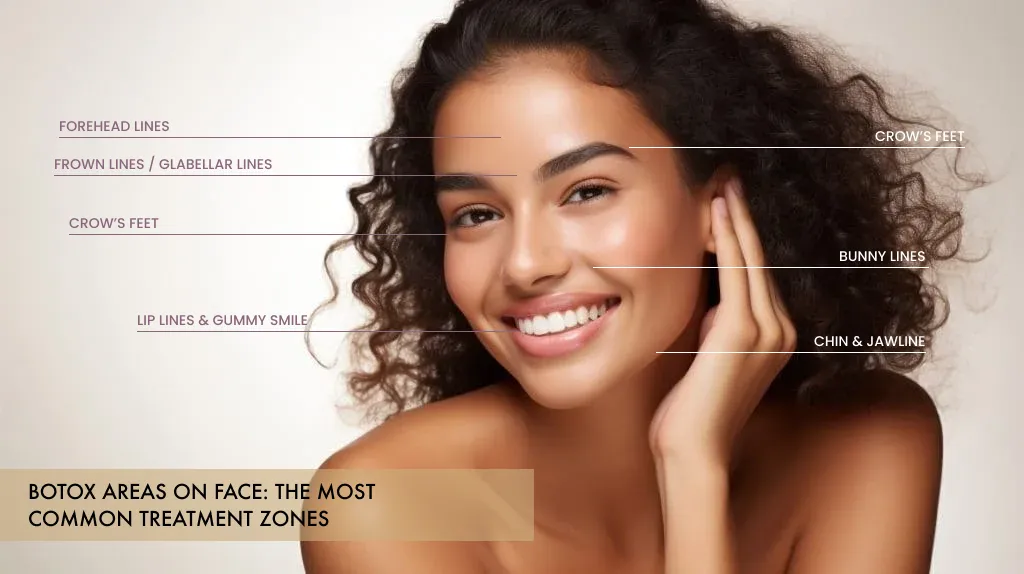
Here are the 7 most popular treatment zones for face Botox areas, with what to expect, typical units, and outcomes. This section covers the areas of the face most commonly treated with Botox.
| Treatment Zone | Why It’s Popular | Units Range* | What to Expect |
| 1. Forehead Lines | Horizontal lines formed when raising brows. Smooth brow motion improves youthful appearance. | 10-25 units | Within 3-7 days, reduced line visibility. Slight heaviness possible for the first 1-2 days. |
| 2. Frown Lines / Glabellar Lines (“11s”) | Deep vertical lines between eyebrows from frowning; strong impact on perceived sternness. | 15-30 units | Softer glabellar region, fewer vertical furrows. Possible mild bruising. |
| 3. Crow’s Feet (Lateral Eye Lines) | Smiles and squints produce “crow’s feet.” Very common area to treat. | 10-20 units per side | Lines soften; smiles remain natural. Avoid over-relaxation. |
| 4. Eyebrow Lift (Brow Area) | A slight lift of the brows improves an open-eyed look. Good in combination with forehead botox. | 4-12 units (per side) | Mild lift visible; some mild heaviness if too many units. |
| 5. Bunny Lines (Side of Nose) | Wrinkles at the top of the nose when smiling or scrunching. Often neglected, but adds refinement. | 5-10 units total | Subtle smoothing; natural expression preserved. |
| 6. Lip Lines & Gummy Smile | Lip lines (“smoker’s lines”) & excessive gum show when smiling. Botox can reduce both. | 2-6 units (lip) / 3-6 units (gummy smile) | Softer lip perimeter; smile reveals less gum. Careful placement is critical. |
| 7. Chin & Jawline (Masseter, Dimpling) | Chin dimpling (“orange peel” skin), masseter reduction for contouring or bruxism relief. | Masseter: 20-40 units per side; Chin: 5-15 units | Smoother chin texture; slimmer jaw angle with masseter treatment. Some soreness possible. |
*Units are general estimates. Your provider will precisely map your Botox areas and units based on muscle strength, facial anatomy, and previous treatments.
1. Forehead Lines (Horizontal Lines)
Horizontal forehead lines form when the frontalis muscle lifts the brow — every raised eyebrow, every moment of surprise. In clients in their late 20s, these lines appear only with movement. By the mid-30s and beyond, they often stay visible at rest.
What to expect:
- Units: 10–25, based on muscle strength and brow position
- Results visible within 3–7 days; full effect at 10–14 days
- Possible slight brow heaviness for the first day or two as the muscle adjusts
One important clinical note: the frontalis is also the muscle that holds the brow up. Treating the forehead without considering the glabellar complex can drop the brow.
Many clients begin conservative forehead treatment at this stage (fewer units, more injection points) to modulate muscle movement before lines become etched into the skin. This approach, sometimes called Baby Botox, is about prevention, not about correction.
2. Frown Lines / Glabellar Lines (“11s”)
The vertical lines between the brows — medically called glabellar lines — develop from years of frowning, concentrating, and squinting. They’re nicknamed “11s” for the parallel pattern they create. Of all the Botox injection areas, this one has the most impact on perceived expression: deep glabellar lines can make a rested face read as angry or stressed.
What to expect:
- Units: 15–30 (men typically require the higher end due to greater muscle mass)
- Softer glabellar region; reduced appearance of tension
- Mild bruising is possible — the area is vascular
The glabellar complex involves five muscles working together. A smoothed “11s” area with some residual movement looks natural, but a completely immobile glabellar region does not.
3. Crow’s Feet
Every genuine smile activates the orbicularis oculi — the circular muscle surrounding the eye. The radiating lines it creates at the outer corners are crow’s feet, and they’re among the most commonly requested areas for Botox among clients aged 30–55.
What to expect:
- Units: 10–20 per side
- Lines soften; smile animation is preserved
- Onset within 3–7 days
The goal here is modulation. A completely frozen lateral eye looks unnatural precisely because it doesn’t move when the rest of the face does. The Skincare Sommelier team evaluates how much of the crow’s feet is dynamic (movement-only) versus static (present at rest) — because static lines require fewer units, not more.
4. Eyebrow Lift
As the brow descends with age, the eye can appear smaller and heavier. A targeted injection above the outer brow relaxes the depressor fibers of the orbicularis oculi, allowing the frontalis to lift slightly — creating a subtle arch without surgery. The lift is typically 1–3mm, which sounds minimal but reads as meaningfully more open and alert.
What to expect:
- Units: 4–12 per side
- Best combined with forehead and glabellar treatment for a balanced result
- Incorrect placement or excessive units can cause asymmetry — this is a precision zone
The chemical brow lift works particularly well for clients who feel their eyes look heavy or tired despite adequate sleep. It’s also a natural complement to the Nefertiti lift protocol, which addresses the lower face and jaw angle using a similar principle of releasing downward-pulling muscles.
5. Bunny Lines (Nose Area)
Bunny lines appear on the sides of the nose bridge when smiling or scrunching — from contraction of the nasalis muscle. They’re often overlooked, but they become more visible after upper-face treatment: relaxing the forehead and glabellar muscles can shift expressive work toward the nose.
What to expect:
- Units: 5–10 total
- Subtle smoothing of nasal movement during expressions
- Natural animation preserved; nasal breathing unaffected
Treating bunny lines adds refinement to an overall balanced result. The Skincare Sommelier team reviews the entire expressive face and flags this zone when it’s likely to become more noticeable after upper-face treatment — even if it wasn’t the original concern.
6. Lip Lines & Gummy Smile
Two separate concerns, often addressed in the same appointment:
Lip lines (sometimes called perioral lines) are vertical creases above the upper lip from repeated orbicularis oris contraction — speaking, drinking, natural lip movement. They appear regardless of smoking history, despite the common nickname.
Gummy smile occurs when the levator labii superioris alaeque nasi muscle pulls the upper lip too high during smiling, revealing excessive gum tissue.
What to expect:
- Lip lines: 2–6 units along the upper lip border
- Gummy smile: 3–6 units into the levator labii
- Softer lip perimeter; less gum visible when smiling
- This zone requires conservative dosing — the difference between a refined result and one that affects speech or lip movement is a matter of units
“Perioral Botox is where I slow down the most. A couple of units placed slightly off can affect how someone drinks from a straw for three months. We always start conservatively here and reassess at the two-week follow-up.” — Clinical specialist, Skincare Sommelier Beauty Lab
7. Chin & Jawline (Masseter, Dimpling)
Three distinct concerns in the lower face, each with different anatomy and outcomes:
Chin dimpling (“orange peel” texture) results from the mentalis muscle over-contracting. Relaxing it smooths the skin surface — 5–15 units, visible within one to two weeks.
Masseter reduction addresses the large chewing muscle at the jaw angle. When the masseter is hypertrophied — from bruxism, habitual clenching, or genetics — it widens the lower face and creates chronic jaw tension. Botox gradually reduces its mass over a series of treatments, slimming the jaw angle and relieving pressure. Units: 20–40 per side. Visible jaw slimming develops over 4–6 weeks; full effect builds over two to three months of consistent treatment. Many clients notice secondary benefits — reduced headache frequency, less tooth sensitivity, and better sleep.
Jaw contouring with Botox can also be extended along the jawline border and into the upper neck bands (platysmal bands) — a technique that defines the jaw angle and creates a cleaner lower-face silhouette without fillers or surgery.
Explore more about the difference between Botox and Dermal Fillers for wrinkles in our guide.
Beyond the Face: Additional Botox Areas of Treatment
Botox treatment areas extend well beyond facial cosmetics:
- Neck / platysmal bands — vertical neck cords that soften with 10–30 units, contributing to jaw definition when combined with lower-face treatment
- Underarms (axillary hyperhidrosis) — FDA-approved for excessive sweating; approximately 50 units per side, effective for 4–6 months, clinically shown to reduce sweat production significantly
- Palms and soles — hyperhidrosis of hands and feet; less common but effective with topical anesthesia for comfort
- Chronic migraine — FDA-approved protocol of 31 injections across seven head and neck muscle areas, administered every 12 weeks
Botox Areas and Units: Full Reference Table

Understanding Botox areas and units is essential to plan cost, downtime, and safety.
| Area | Typical Units Range | Key Variables |
| Forehead | 10-25 | Muscle strength, brow position, age |
| Glabellar (“11s”) | 15-30 | Line depth, muscle mass, gender |
| Crow’s Feet | 10-20 per side | Dynamic vs. static lines, sun damage |
| Eyebrow Lift | 4-12 per side | Natural brow position, anatomy |
| Bunny Lines | 5-10 | Nasal movement pattern |
| Lip Lines | 2-6 | Line depth, lip movement frequency |
| Gummy Smile | 3–6 | Degree of gum visibility |
| Chin Dimpling | 5-15 | Chin muscle tone, creases |
| Masseter / Jaw | 20-40 per side | Muscle hypertrophy, bruxism severity |
| Neck Bands | 10-30 | Vertical platysmal strength, skin laxity |
| Underarms | ~50 per axilla | Sweat gland activity, area size |
These are clinical reference ranges. The Skincare Sommelier team determines precise units at consultation based on facial mapping, muscle assessment, and individual treatment history.
Best Areas to Get Botox for Natural Results
Choosing the best areas to get botox is about balancing aesthetic goals, age, skin condition, and preserving facial dynamics. Here’s how to approach it:
- Start conservatively — treat 1-2 zones first (e.g., glabellar + forehead), see results, then expand.
- Assess facial balance — over-treating one area can lead to unnatural expressions.
- Prioritize zones that age first — for many clients, forehead lines and crow’s feet show earliest.
- Consider medical benefits — bruxism, sweat, migraines might factor into area selection.
Popular combinations in NY med spas include:
- Forehead + Glabellar lines
- Crow’s Feet + Eyebrow Lift
- Masseter + Chin dimpling (for jaw contour + chin texture)
These combinations address both aesthetics and expression, reducing signs of aging while maintaining natural movement.
Read more: Benefits of Botox Injections
Common Myths About Botox Injection Areas
Myth 1: Does Botox Lead to a Frozen or Expressionless Face?
Botox relaxes specific muscles — it doesn’t affect all facial muscles or eliminate expression. The frozen look comes from over-treatment, not the treatment itself. Properly dosed Botox softens movement while preserving animation.
Myth 2: Are the Effects of Botox Identical for Every Injection Area?
Every zone has different muscle anatomy, movement patterns, and neighboring structures. Crow’s feet treatment must preserve smile movement. Perioral treatment requires a fraction of the units used elsewhere. Results vary because anatomy varies.
Myth 3: Does Every Patient Require the Same Number of Botox Units?
Unit needs depend on muscle mass, gender, age, prior treatment history, and individual response. A 28-year-old beginning preventive treatment and a 50-year-old correcting established lines are not starting from the same place — and shouldn’t be treated as if they are.
Choosing the Right Clinic for Botox Treatment Areas in Forest Hills, NY
SFor clients searching for Botox near me in Queens, Forest Hills, or surrounding New York neighborhoods, the consultation process matters as much as the injector’s technical skill.
At Skincare Sommelier Beauty Lab & Med Spa, every Botox appointment includes facial mapping, expression assessment in animation (not just at rest), transparent unit discussion, and honest scope-setting about what treatment will and won’t address. Only FDA-approved botulinum toxin products are used.
“The goal is always elegance of your unique anatomy, not erasure of expressions and wrinkles.” — Clinical specialist, Skincare Sommelier Beauty Lab
FAQ: Botox Areas
How long do Botox results last?
Most Botox areas last 3–4 months. The masseter is an exception — repeated treatment causes gradual muscle atrophy, and results can persist for 6 months or longer.
Can multiple Botox areas be treated in one session?
Yes. Treating the forehead, glabellar lines, and crow’s feet in one appointment is standard. A full-face session may include additional zones. The limiting factor is the total appropriate unit count for your anatomy, not the number of zones.
Does Botox in one area affect neighboring muscles?
When placed correctly, Botox stays within the targeted muscle. Diffusion to adjacent muscles is possible with excessive units or imprecise placement — the most common example being forehead Botox affecting brow position. This is why dosing precision matters.
What is the difference between Botox treatment for men and women?
Men typically have larger, stronger facial muscles and require higher unit counts — particularly in the glabellar and masseter regions. Treatment goals also differ: male clients more often prioritize expression preservation over smooth forehead aesthetics.
Is Masseter Botox painful?
The masseter is a large muscle with less surface nerve density than the forehead. Most clients describe brief, dull pressure rather than sharp pain. Mild post-treatment soreness, similar to post-workout muscle fatigue, is common for one to two days.
Can Botox fix lines that are visible at rest?
Botox works on dynamic wrinkles — lines created by muscle movement. Lines present at rest may partially soften as the underlying muscle relaxes, but deep static wrinkles often require complementary treatments: dermal fillers, skin resurfacing, or biostimulating protocols alongside Botox.
How soon can I return to normal activities?
Immediately for most activities. For the first four hours after treatment, avoid lying flat, intense exercise, and rubbing the treated areas — this reduces the small risk of product migration from injection sites.
What is Baby Botox?
Baby Botox refers to a conservative microdosing approach — fewer units placed at more injection points — to modulate muscle movement rather than fully relax it. It’s particularly suited to clients in their 20s and early 30s who want early prevention while maintaining full natural expression.
Which Botox areas should a first-time client start with?
A conservative first session typically covers the glabellar lines and the forehead together — these two zones are anatomically linked and most impactful for overall facial expression. Crow’s feet are often added. Starting with one to two zones, assessing results, and then expanding is the standard approach at Skincare Sommelier.
How do I know which areas are right for me?
The answer depends on which lines concern you most, what your facial muscle assessment shows, and your goals. A consultation that includes expression mapping — not just a conversation about preferences — is the most reliable starting point. Anatomy, not trends, should drive the decision.
Is Botox safe for all skin tones?
Yes. Botox targets muscle tissue, not the skin itself — it is not affected by Fitzpatrick skin type. The safety and dosing considerations are the same across all skin tones.
How far in advance should I book before an event?
Botox takes 3–14 days to reach full effect, and occasional mild bruising can last a few days. Booking two weeks before a significant event gives enough time to see the full result and address any minor touch-ups if needed.
Conclusion About Botox Areas
The seven most popular Botox areas — forehead, glabellar lines, crow’s feet, eyebrow lift, bunny lines, lip lines, gummy smile, chin, and jawline — each have distinct anatomy, unit requirements, and outcome profiles. Treating them well means understanding how they interact, not addressing zones in isolation.
Natural-looking results come from anatomy-matched treatment, conservative dosing, and consistent maintenance — not from treating every possible zone at once. If you’re in Forest Hills, Queens, or greater New York City and want to explore which Botox areas are appropriate for your face and goals, the conversation starts with a consultation at Skincare Sommelier Beauty Lab & Med Spa.
Botox treatment in Forest Hills, Queens, NYC
Book a consultation with our expert team today using our online contact form.
Or call our clinics directly on 718-814-6704
How To Find Us – Botox treatment near me
112-05 75th Avenue, Forest Hills, NY 11375