
Table of Contents
Dark spots don’t fade on their own — and in a city like New York, where stress, pollution, and year-round UV exposure keep melanin overactive, the right chemical peel can make a measurable difference. At Skincare Sommelier Beauty Lab & Med Spa in Forest Hills, we see hyperpigmentation daily: post-acne marks on deeper skin tones, melasma flares after summer, sunspots accumulating decade by decade.
This guide covers everything you need to know — the seven most clinically effective peels, how to choose the right one for your skin type and Fitzpatrick tone, what the results actually look like week by week, and the protocols that combine peels with next-generation treatments.
At a Glance: Chemical peels treat hyperpigmentation by accelerating cell turnover and dispersing melanin. The most effective options range from gentle Mandelic Acid (safe for dark skin tones) to deep TCA peels for sun damage. Most NYC patients see 35-60% improvement after a series of 4-6 sessions.
Read more: Hydrating Facials for Barrier Repair & Glow
What Is Hyperpigmentation: Causes and Care
Hyperpigmentation occurs when melanocytes — the cells responsible for skin pigment — overproduce melanin in response to a trigger. The result: patches, spots, or uneven tone that can range from barely noticeable to deeply affecting confidence.
According to the American Academy of Dermatology (AAD), UV exposure accounts for up to 80% of visible facial pigmentation in adults. But the sun isn’t the only culprit.
Causes of Hyperpigmentation
- UV radiation — activates melanocytes and creates sunspots, solar lentigines, and tonal unevenness. Even brief, daily exposure accumulates over time.
- Hormonal shifts — melasma is directly linked to estrogen fluctuations from pregnancy, oral contraceptives, and perimenopause. Heat amplifies it.
- Post-inflammatory hyperpigmentation (PIH) — follows acne, eczema flares, waxing irritation, or any trauma. Particularly persistent in Fitzpatrick IV–VI.
- Cumulative aging — freckles deepen, age spots multiply, and overall luminosity diminishes with decades of unprotected exposure.
How to Recognize Hyperpigmentation
- Persistent dark patches or spots
- Areas that remain for several skin cycles despite sunscreen use
- Symmetrical discoloration (melasma)
- Freckling and uneven tone after summer exposure
Why Pigmentation Returns Without the Right Strategy
This is the part most people skip. A single peel session can temporarily fade a dark spot — but without consistent SPF, barrier support, and a maintenance protocol, melanin overproduction can resume. The AAD notes that regular SPF use reduces the recurrence of pigmentation by 30–50%.
At Skincare Sommelier, we build peel programs around this reality: the peel series clears what’s there; the maintenance protocol prevents what’s next.
Clinical Remark: Depth matters before you pick an acid. A consultation to determine whether your pigment is epidermal, dermal, or mixed will determine which peel will work — and which could trigger a rebound.
Explore: Professional Hyperpigmentation Treatments →
What Are Chemical Peels for Hyperpigmentation?
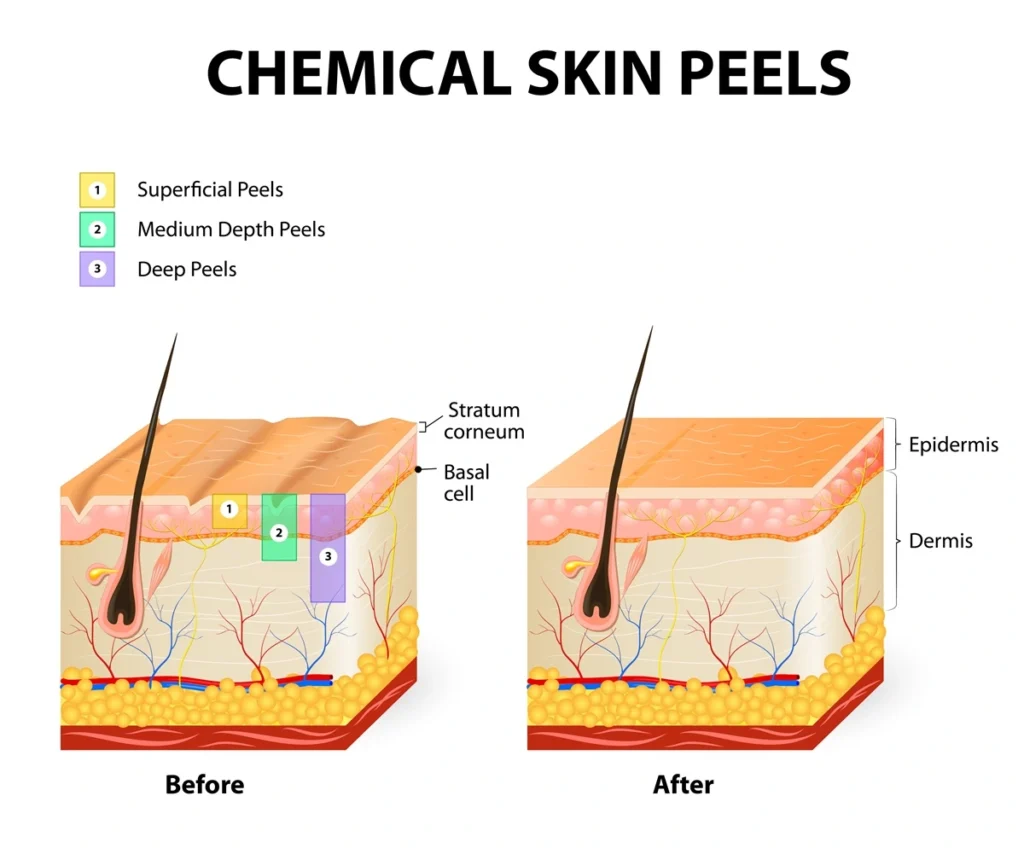
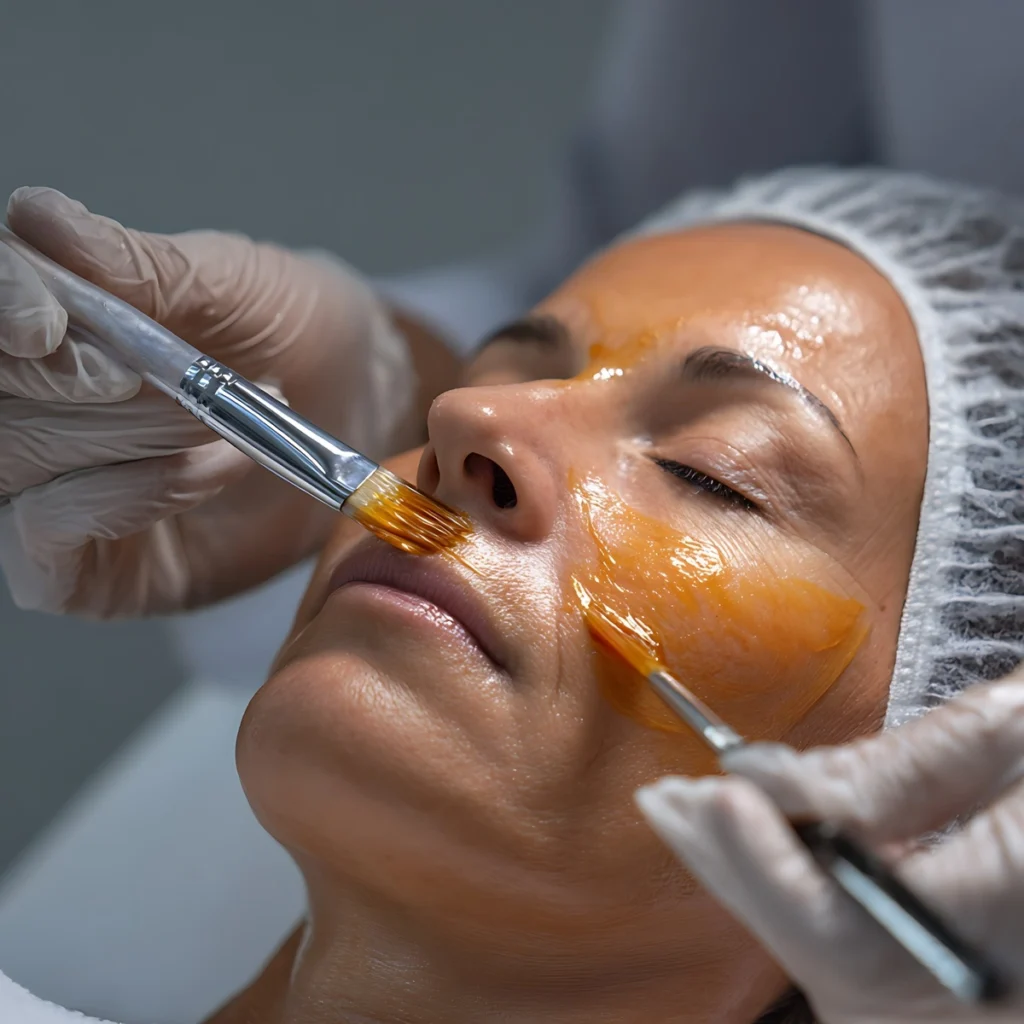
Chemical peels apply controlled concentrations of exfoliating acids to the skin. The acid dissolves the bonds between dead surface cells, accelerates cellular turnover, and disperses accumulated melanin in the upper skin layers. Deeper formulas can also signal fibroblasts to rebuild collagen — adding a texture benefit alongside brightening.
Peel depth levels:
- Superficial peels — target the stratum corneum and upper epidermis. Ideal for mild discoloration, first-time clients, and maintenance. Minimal downtime (1–3 days of light flaking).
- Medium-depth peels — reach the papillary dermis. More effective for stubborn or mixed-depth pigment, melasma, and significant sun damage. Downtime 5–10 days.
The Journal of Clinical and Aesthetic Dermatology (JCAD) reports that a series of glycolic acid peels can reduce pigmentation by 35–60% over six sessions. Results are cumulative — each session builds on the last.
Standard protocol: sessions every 2–4 weeks, series of 4–6 depending on pigment depth and skin response.
AHA vs. BHA: Understanding the Two Main Peel Families
Alpha-hydroxy acids (AHAs) — glycolic, lactic, mandelic — are water-soluble. They work primarily on the skin’s surface, dissolving dead-cell bonds to boost turnover, brighten tone, and fade superficial pigmentation. Best for most hyperpigmentation types.
Beta-hydroxy acids (BHAs) — primarily salicylic acid — are oil-soluble. They penetrate inside pores, dissolving sebum buildup and reducing inflammation. The right choice when hyperpigmentation is linked to active or post-acne skin.
Many advanced protocols use a combination of both — layered or alternated — for comprehensive correction.
The 7 Most Popular Types of Chemical Peels for Hyperpigmentation
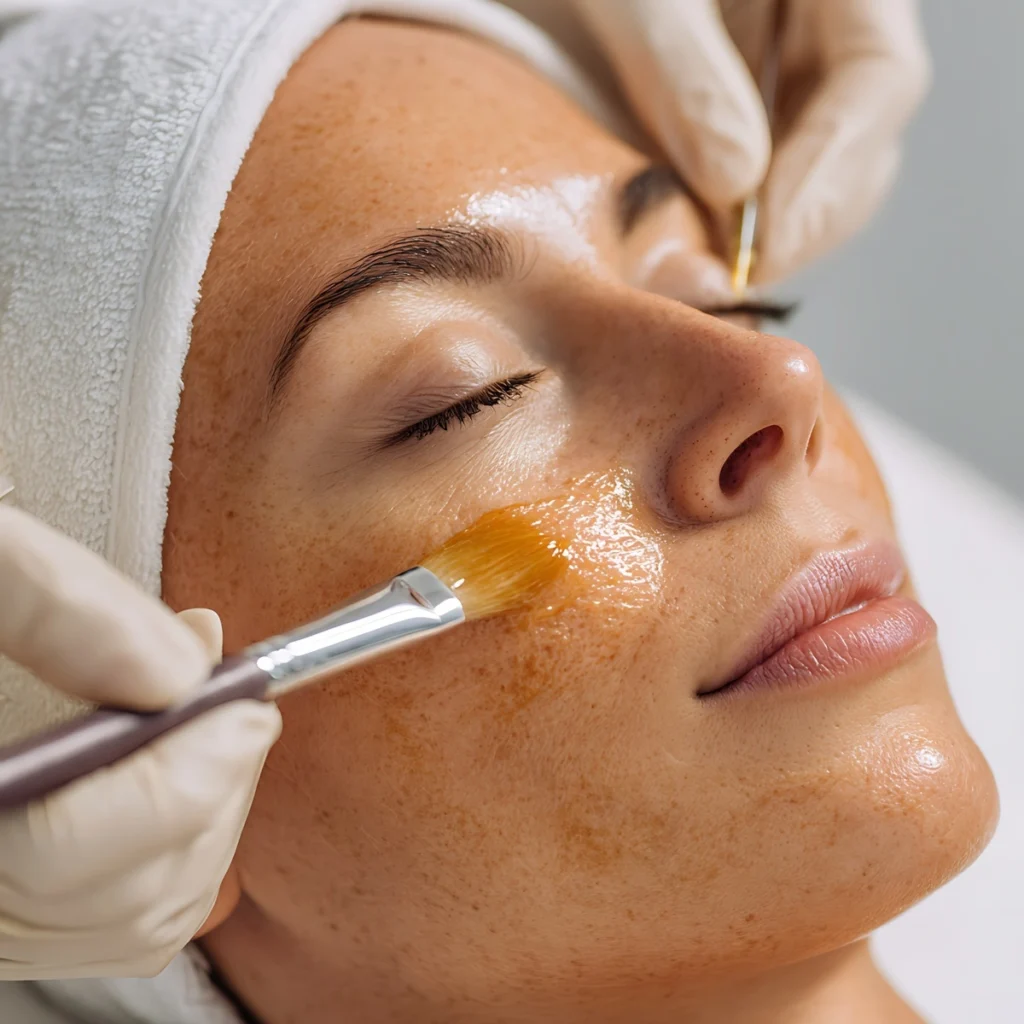
1. Salicylic Acid Peel (BHA) — for Acne-Linked PIH
How it works: Exfoliates within the pore, breaks down post-acne pigmentation, and reduces the inflammation that triggers melanin overproduction in the first place. Unlike AHAs, it doesn’t just surface-exfoliate — it clears the pathway that leads to PIH.
Best for: Oily, congestion-prone, and acne-active skin; post-inflammatory dark marks; Fitzpatrick III–VI.
What to expect: Mild tingling during application. Light flaking days 2–4. Visible softening of dark marks after 2–3 sessions. Best combined with azelaic acid home care for ongoing PIH prevention.NYC tip: An excellent starter peel for clients with both active acne and residual marks. Can be used year-round with consistent SPF.
2. Glycolic Acid Peel (AHA) — for Sunspots & Uneven Tone
How it works: The smallest AHA molecule, low molecular weight, allows deeper epidermal penetration. Disperses melanin clusters, stimulates collagen synthesis, and improves overall skin radiance. Among the most well-researched brightening acids available.
Best for: Sunspots, solar lentigines, mild-to-moderate melasma, age-related tonal unevenness, Fitzpatrick I–IV.
What to expect: Noticeable brightening after sessions 2–3. Significant improvement in dark spot intensity after a full series of 6. Skin continues improving for 2–3 weeks post-session as cell turnover completes.Forest Hills seasonal tip: Glycolic peels are most effective — and safest — in fall and winter, when NYC UV index is at its lowest. Summer clients should stick to lower concentrations with strict SPF protocols.
3. TCA (Trichloroacetic Acid) Peel — for Stubborn Pigment
How it works: TCA creates a controlled medium-depth wound, prompting the skin to shed its upper layers and regenerate fresh, evenly pigmented tissue. The “frosting” effect — a white film on the skin — signals effective penetration depth.
Best for: Treatment-resistant melasma, deep or mixed-depth pigmentation, significant sun damage, clients who haven’t responded to superficial peel series.
What to expect: 5–10 days of real downtime — redness, tight skin, visible peeling. Results are dramatic. Not a lunchtime treatment. Requires strict post-peel photoprotection.Important: TCA is a clinic-only procedure. Concentration and layering techniques are critical to safety — especially for darker skin tones, where the risk of rebound pigmentation is higher. Always performed by a licensed specialist at Skincare Sommelier.
4. Lactic Acid Peel (Gentle AHA) — First-Timer & Barrier-Rebuilding Option
How it works: Lactic acid is derived from milk and has a larger molecular size than glycolic, meaning slower, gentler penetration. It exfoliates and brightens while simultaneously drawing moisture into the skin — a rare peel that improves pigmentation without compromising the skin’s barrier function.
Best for: First-time peel clients, reactive or sensitized skin, mild discoloration, and anyone recovering from over-exfoliation or barrier damage. Excellent preparatory peel before advancing to a glycolic or mandelic peel.What to expect: Minimal to no visible peeling. Gradual brightening over 3–4 sessions. Skin feels noticeably softer and more hydrated immediately. Ideal entry point for clients hesitant about peel recovery.
5. Mandelic Acid Peel (Large-Molecule AHA)
How it works: Mandelic acid has the largest molecular structure among AHAs, resulting in the slowest penetration rate. This precision makes it uniquely effective for sensitive and darker skin tones — it gradually brightens PIH without triggering the inflammatory response that can cause rebound hyperpigmentation.
Best for: Fitzpatrick IV–VI skin, sensitive or acne-prone skin, post-inflammatory hyperpigmentation (PIH), clients with prior PIH from aggressive treatments.
What to expect: Gentle, consistent improvement over 4–6 sessions. Minimal peeling. Significantly lower risk of post-peel PIH compared to glycolic or TCA. Often combined with niacinamide or azelaic acid for enhanced brightening.
Update: Mandelic acid is increasingly featured in combination protocols for skin of color in NYC practices — paired with LED therapy to reduce inflammation and accelerate results safely.
Explore: Infrared LED Sauna Therapy with Mandelic acid in Forest Hills, NY →
6. Vitamin C Facial Peel — Antioxidant Brightening
How it works: Unlike acid peels that exfoliate, a vitamin C peel works by inhibiting tyrosinase — the enzyme that drives melanin production — while neutralizing the free radical damage from UV and pollution that triggers pigmentation in the first place. It also supports collagen synthesis, improving overall skin quality.
Best for: Maintenance between deeper peel sessions, mild diffuse pigmentation, dull or pollution-stressed skin, clients who want brightening with near-zero downtime.What to expect: Immediate radiance boost, no peeling. Best used as part of a series protocol — alternated with exfoliating peels to stabilize pigment pathways between active correction sessions.
7. Jessner Peel (Resorcinol + Lactic Acid + Salicylic Acid) — The Combination Corrector
How it works: The Jessner solution layers three acids into a single formula: resorcinol loosens surface skin cells, lactic acid hydrates and brightens, and salicylic acid penetrates into oil and controls inflammation. The result is more controlled, even exfoliation than any single-acid peel provides.
Best for: Melasma, PIH combined with acne, complex mixed pigmentation, patients who want deeper results without committing to full TCA downtime.
What to expect: Moderate peeling days 3–6. Noticeable brightening after 2–3 sessions. Can be layered with TCA for significantly deeper correction in clinical settings.Clinical note: Jessner peels are ideal for NYC clients dealing with melasma that doesn’t respond to single-acid approaches. The layered mechanism addresses multiple pigmentation pathways simultaneously.
How to Choose the Right Peel for Your Skin
Peel selection is never one-size-fits-all. The right choice depends on five clinical factors evaluated at consultation:
- Pigment depth — epidermal pigment (closer to the surface) responds to superficial peels; dermal or mixed-depth pigment requires medium-depth formulas.
- Fitzpatrick skin type — deeper tones (IV–VI) benefit most from mandelic, lactic, or customized low-strength blends with lower rebound risk.
- PIH history — if previous treatments triggered post-inflammatory darkening, gentler formulas and pre-conditioning (vitamin C, niacinamide, azelaic acid) are prioritized.
- Active skin conditions — acne-active skin benefits from salicylic; compromised barrier needs lactic first.
- Season and UV exposure — stronger pigment-correcting peels are most effective in fall/winter in NYC, when UV index is lowest and post-peel photoprotection is easier to maintain.
Skincare Sommelier Protocol: Every client receives a Fitzpatrick-matched peel plan with a clear session schedule, home care routine, and SPF protocol built in. Improvement should be consistent — not a gamble.
Chemical Peels for Fitzpatrick Skin Tone
Hyperpigmentation disproportionately affects people with Fitzpatrick IV–VI skin tones — and so do the risks of poorly selected treatments. At Skincare Sommelier, this is one of our most requested conversations.
The core issue is that melanocytes in Fitzpatrick IV–VI skin tones are more reactive. Aggressive peels or improper aftercare can trigger post-inflammatory hyperpigmentation and make it worse. This is why acid selection, concentration, and post-peel protocol are non-negotiable.
Safest Acids for Fitzpatrick IV–VI:
- Mandelic acid — slowest penetration, lowest PIH risk.
- Lactic acid — gentle, hydrating, minimal inflammatory response.
- Low-concentration salicylic acid — safe for PIH when properly dosed and monitored.
- Customized Jessner blends — when formulated conservatively by a specialist.
What to avoid or use with extreme caution: high-concentration glycolic, aggressive TCA applications, and any peel on skin that hasn’t been preconditioned for 2–4 weeks.
At Skincare Sommelier, pre-conditioning routines for skin include niacinamide, azelaic acid, and vitamin C — ingredients that calm melanocytes before the peel series begins, reducing the inflammatory response and the risk of rebound.
Combination Protocols: What’s New in Pigmentation Treatment
The most significant shift in aesthetic practice over the past two years isn’t a new acid — it’s the strategic combination of peels with complementary treatments for faster, more stable results.
Peel + LED Therapy
A red and near-infrared LED applied immediately after a peel session reduces inflammation, accelerates healing, and supports cellular repair. This combination dramatically lowers post-peel PIH risk. Now standard protocol at Skincare Sommelier for Fitzpatrick IV–VI clients.
Peel + Microneedling (Sequential Protocol)
Chemical peels address epidermal pigment fastest. Microneedling reaches deeper texture irregularities and stimulates collagen for comprehensive skin remodeling. Alternating the two — not performing them on the same day — allows the skin to fully recover between sessions while compounding results. Most NYC clients dealing with both pigmentation and post-acne scarring benefit significantly from this approach.
Peel + Topical Pigment Inhibitors
Pairing a peel series with prescription-strength or high-efficacy topicals — tranexamic acid, azelaic acid, kojic acid, or physician-prescribed hydroquinone — creates a two-pronged approach: the peel removes existing pigment; the topicals prevent new overproduction. This is the standard protocol for melasma management.
PHA Peels as a Gentle Alternative
Polyhydroxy acids (PHAs) — including gluconolactone and lactobionic acid — are emerging as the gentlest option for reactive skin types. They provide exfoliation benefits similar to AHAs but with a larger molecular size, slower absorption, and built-in antioxidant and humectant properties. Ideal for clients who’ve had inflammatory reactions to traditional peels.
Microneedling vs. Chemical Peels for Hyperpigmentation
Expert Note
“Peels work best for epidermal pigment, while microneedling can address both pigment and texture. Many NYC patients benefit from combining the two.”
– Clinical Aesthetic Specialist, Skincare Sommelier
| Factor | Chemical Peels | Microneedling |
| Primary Action | Exfoliate & disperse melanin | Stimulate remodeling |
| Best for | Epidermal PIH, sunspots | Scars + pigment |
| Downtime | 1–10 days | 1–3 days |
| Series | 3–6 sessions | 3–6 sessions |
| Skin of Color | Mandelic/lactic best | Lower settings recommended |
Read more: Microneedling vs Chemical Peel: Which Is Better for Pigmentation?
Chemical Peel Results: What to Expect Week by Week
After Session 1 of Peels
- Days 1–2: Skin may appear slightly flushed or feel tight.
- Days 3–5: Light flaking or peeling (superficial peels). More visible peeling with medium-depth formulas.
- Days 7–10: Fresh skin visible. Initial brightening noticeable. Dark spots may temporarily appear more defined before they lighten.
After Sessions 2–3 of Peels
- Visible reduction in PIH intensity for post-acne marks.
- Sunspots and solar lentigines are beginning to fade meaningfully.
- Skin texture improves alongside tone. Overall complexion is more even.
After a Full Series (4–6 Sessions) of Peels
- 35–60% reduction in pigmentation (per JCAD data on glycolic series).
- Melasma significantly lighter — most manageable with maintenance protocol.
- PIH in Fitzpatrick IV–VI skin faded; reduced risk of recurrence with ongoing SPF.
- Optimal luminosity, tone evenness, and texture refinement.
Important: Results vary based on pigment depth, skin type, sun care adherence, and home care consistency. Realistic timelines are discussed at consultation — not one session, not overnight.
How to Prepare for a Chemical Peel
Preparation directly affects peel performance, downtime, and risk of post-peel complications. Follow these guidelines for the 5–7 days before treatment:
- Discontinue retinoids, exfoliating acids (AHA/BHA), and physical scrubs.
- Switch to a gentle cleanser and basic hydrating moisturizer.
- Avoid sun exposure, tanning, and artificial UV for at least 48 hours.
- Skip waxing or depilatory treatments — skin sensitivity is elevated.
- No saunas, steam rooms, or intense workouts 24 hours prior.
- Disclose all active medications, past PIH reactions, or skin sensitivities at consultation.
- Optional pre-conditioning for pigment-prone skin: vitamin C, azelaic acid, or niacinamide for 1–2 weeks.
Post-Peel Aftercare: Protect and Prolong Your Results
The 7–10 days after a peel are when most people make mistakes that compromise results or cause complications. Correct aftercare is non-negotiable.
- SPF 50 every single morning — reapply every 2 hours if outdoors. This is the most important step for preventing pigmentation recurrence.
- Cleanse with a gentle, non-foaming cleanser twice daily.
- Moisturize consistently — hydrated skin heals faster and peels more evenly.
- Do not pick, rub, or peel flaking skin. Let it shed naturally.
- Avoid retinoids, AHAs, BHAs, and all active ingredients until peeling is complete (typically 5–7 days).
- Skip intense workouts, heat exposure, and steam rooms for 5–7 days — heat triggers melanin production.
- No makeup for at least 24 hours post-peel (48 hours recommended for medium-depth peels).
More: Results, Expected Downtime, and Real Costs of Microneedling
Who Should Avoid Chemical Peels?
Chemical peels are safe for most clients when properly selected and performed. However, postpone treatment if any of the following apply:
- Active skin infections, cold sores, or open wounds in the treatment area.
- Recent or current sunburn.
- Currently taking isotretinoin (Accutane) — wait 6–12 months post-course.
- Taking photosensitizing medications (certain antibiotics, diuretics, retinoids).
- Pregnancy — several acids are restricted; discuss with your provider.
- Known keloid or hypertrophic scarring tendency.
- Compromised skin barrier or active eczema/rosacea flare.
FAQ: Chemical Peels for Hyperpigmentation
What is the best chemical peel for hyperpigmentation?
It depends on your skin tone and pigment type. For most skin types, glycolic, lactic, or mandelic peels deliver excellent results. For stubborn melasma or treatment-resistant PIH, Jessner or TCA peels provide deeper correction. A consultation is the only reliable way to match the right peel to your specific pigmentation.
How many chemical peel sessions do I need to see results?
Most clients in NYC notice initial brightening after 1–2 sessions. Significant dark spot reduction is visible after 3–6 sessions, spaced 3–4 weeks apart. Melasma and deep PIH typically require a full series plus a maintenance protocol for lasting improvement.
Are chemical peels safe for darker skin tones (Fitzpatrick IV–VI)?
Yes — when using mandelic, lactic, or customized low-strength blends. At Skincare Sommelier Beauty Lab, we tailor formulations to prevent PIH.
What type of peel is best for melasma?
Melasma typically responds best to AHA-based peels (such as mandelic or glycolic), Jessner peels, and targeted pigment-safe blends. Ferulic and azelaic acid peels are also commonly used because they reduce inflammation and help regulate melanin production. A multimodal plan (peels + daily SPF + pigment inhibitors) provides the most reliable improvement.
Can a chemical peel make hyperpigmentation worse?
Yes, but only if performed incorrectly or using aggressive acids on deeper skin tones. Proper selection + professional application prevent worsening.
Is there downtime after a chemical peel?
Superficial peels: 1–3 days of light flaking.
Medium-depth peels: 5–10 days of peeling and redness.
How much do chemical peels for hyperpigmentation cost in NYC?
In Forest Hills and most NYC clinics, prices range from $150–$450 depending on peel type and depth.
How long do results last?
Results typically last 3–6 months with SPF and proper skincare. Maintenance peels every 8–12 weeks prolong results.
Are chemical peels better than microneedling for pigmentation?
Peels lighten dark spots faster, while microneedling improves texture and deeper pigment. The best results often come from alternating treatments.
Can I get a chemical peel during the summer?
Gentle superficial peels (lactic, low-concentration mandelic) are safe in summer with strict SPF adherence. Strong pigment-correcting peels — glycolic, TCA, Jessner — are best reserved for fall and winter when NYC UV levels are significantly lower.
Are chemical peels painful?
Most clients feel mild tingling or warmth for 1–3 minutes. Medium-depth peels may feel more intense but remain tolerable.
How soon will I see results?
You may see brighter skin after 7–10 days. Dark spot reduction becomes noticeable after 2–3 sessions.
Can I combine chemical peels with other treatments?
Yes — and combination protocols often produce superior results. Common pairings include peels with LED therapy (which reduces inflammation and accelerates healing), microneedling (which addresses texture and deeper pigmentation), and pigment-inhibiting topicals. Sequential, not simultaneous.
What should I avoid after a chemical peel?
Avoid sun exposure, active skincare (retinol, AHA/BHA), makeup for 24 hours, sweating, and hot environments for several days.
Who should avoid chemical peels?
Not recommended for pregnant individuals, those taking isotretinoin, people with active infections, or anyone prone to keloids.
Do chemical peels work on acne marks and post-inflammatory hyperpigmentation (PIH)?
Yes, especially glycolic, mandelic, and salicylic blends. PIH typically improves faster than melasma.
Ready to Address Hyperpigmentation?
Not every dark spot is the same — and the peel that transforms one client’s skin can set back another’s. The difference is a personalized consultation that maps your pigment depth, Fitzpatrick type, and lifestyle before selecting a protocol.
At Skincare Sommelier Beauty Lab & Med Spa in Forest Hills, NY, our specialists design peel programs with clear timelines, realistic expectations, and lasting results. We serve clients across Queens and the greater NYC area.
Schedule your consultation today and find out which chemical peel protocol is right for your skin.